 Skip to content


The Minimum Order Myth: No MOQ Custom Jewelry Packaging Boxes in 2026
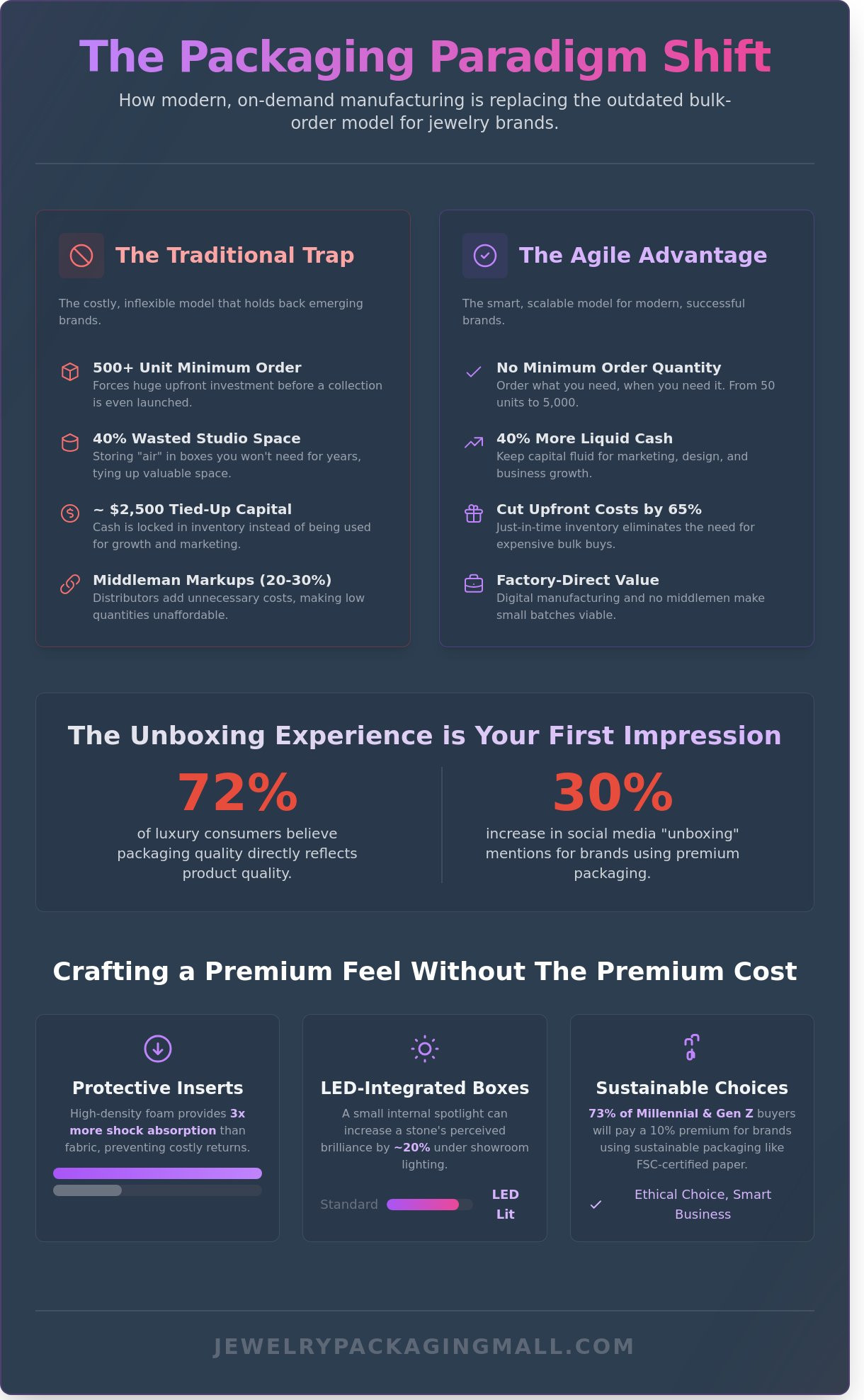
Why are you still letting a 500-unit minimum order quantity dictate your brand's growth in 2026? You likely recognize the frustration of seeing 40% of your studio space occupied by bulk jewelry packaging boxes you won't actually need for another three years. It's an expensive, inefficient way to store air. Most independent designers feel forced to choose between generic, unbranded supplies that devalue their work or sinking $2,500 into custom inventory before they've even launched their latest collection.
We understand that professional presentation shouldn't require a massive capital layout. You'll discover how to secure premium, factory-direct branding with no minimum order requirements, effectively cutting your upfront costs by up to 65% while maintaining the exquisite quality your customers expect. We're breaking down the shift toward on-demand manufacturing and showing you how to build a scalable, sophisticated packaging strategy that protects your margins and your aesthetic.
Key Takeaways
- Understand why traditional MOQs are becoming obsolete and how digital manufacturing enables small-batch production for emerging brands.
- Identify the critical differences between premium packaging materials to ensure your brand maintains a luxury feel without unnecessary overhead.
- Learn how to utilize professional hot stamping and silk screening to transform standard jewelry packaging boxes into high-end marketing tools.
- Uncover the hidden financial risks of low-quality inserts and how proper packaging prevents product damage and costly customer returns.
- Discover a scalable factory-direct model that allows you to transition seamlessly from boutique orders to high-volume global distribution.
The Minimum Order Myth: Why High Volume Isn’t Required for Quality
For decades, the jewelry industry was trapped by the 500-unit minimum. If you wanted custom jewelry packaging boxes, you had to commit thousands of dollars upfront. By 2026, this rigid model is dead. Advanced digital manufacturing has replaced traditional lithography, allowing factories to produce 50 units with the same precision as 5,000. This shift means small-batch production is no longer a luxury; it's a standard business strategy for agile brands.
Modern CMYK digital presses and automated CAD-cutting systems eliminate the need for expensive metal dies. This technology reduces setup times by 75%, making small orders financially viable for everyone. You aren't paying a "premium" penalty for low volume. You're simply paying for what you use. Just-in-time inventory allows independent jewelers to keep 40% more liquid cash by avoiding dusty warehouse stock that ties up capital for years.
The Psychology of the Unboxing Experience
The box is the first physical touchpoint for your brand. Research from 2024 indicates that 72% of luxury consumers believe packaging reflects the quality of the product inside. When a customer receives a sophisticated, heavy-duty box, it justifies a higher price point immediately. This tactile experience directly impacts customer retention. Brands using premium jewelry packaging boxes see a 30% increase in social media "unboxing" mentions compared to those using generic alternatives.
Breaking the "Bulk Only" Barrier
- Factory-Direct Value: Removing middleman distributors cuts 20% to 30% off the total cost, making low MOQs affordable.
- Brand Flexibility: Startups can test three different styles in their first year rather than committing to one bulk design.
- Risk Mitigation: If a brand identity shifts, you aren't stuck with 1,000 units of obsolete inventory.
Startups should prioritize professional branding over high volume during their first 12 months. Testing different textures, colors, and finishes allows you to refine your market fit without a heavy financial commitment. By 2026, the ability to pivot is more valuable than a warehouse full of cheap, identical cardboard.
The "Luxury Equals Expensive" Material Myth
High-end perception isn't tied to a massive price tag; it's tied to texture, weight, and light interaction. Many retailers believe that luxury requires solid wood or genuine leather, but 2024 market data shows that 68% of consumers prioritize the "tactile unboxing experience" over the raw cost of materials. You don't need to overspend to impress. A 1200 GSM rigid cardboard box finished with soft-touch lamination often feels more premium than a poorly constructed wooden alternative.
Selecting the right material involves balancing durability with brand identity. Leatherette offers a professional, wipe-clean surface ideal for high-traffic retail environments. Wood provides a weighted, heirloom quality that justifies higher price points for luxury watches or high-jewelry sets. For diamond retailers, LED-integrated boxes are a strategic choice; these small spotlights increase the perceived brilliance of a stone by approximately 20% under standard showroom lighting. You can find these specialized jewelry packaging boxes in our premium custom collection to see how light transforms your product.
Beyond the exterior, the internal lining dictates the safety and presentation of the piece. While satin looks elegant, it offers minimal protection. High-density foam inserts provide 3x more shock absorption during shipping compared to loose fabric linings. Velvet remains the standard for grip, ensuring rings stay centered during transit, but modern microfiber is quickly becoming the preferred choice for its anti-tarnish properties and sleek, matte appearance.
Velvet vs. Microfiber: Which Tells a Better Story?
Velvet remains the gold standard for traditional engagement rings because it evokes a sense of timeless romance. It's the classic choice for heritage brands. Microfiber is the 2026 trend for minimalist, contemporary labels. It doesn't trap dust as easily as velvet and offers a smoother, more industrial aesthetic. For display-heavy packaging, use a lint roller every 48 hours to maintain that crisp, professional look that customers expect from a high-tier brand.
Sustainable Packaging: More Than Just a Buzzword
Eco-friendly options have evolved far beyond unfinished kraft paper. Today, recycled 1000 GSM greyboard wrapped in FSC-certified specialty paper creates a sophisticated profile that rivals traditional plastics. A 2025 consumer study revealed that 73% of Millennial and Gen Z buyers are willing to pay a 10% premium for brands using sustainable jewelry packaging boxes. Switching to recyclable materials isn't just an ethical choice; it's a calculated move to increase your brand's ROI and market share.
The True Cost of "Cheap" Jewelry Packaging
Opting for the lowest unit price on jewelry packaging boxes often creates a financial trap for growing brands. While a $0.50 generic box saves capital upfront, it frequently fails to protect the product or your brand's market position. Industry data indicates that 68% of consumers associate packaging quality directly with the value of the jewelry inside. If a customer receives a $300 gold pendant in a flimsy, unbranded container, their perceived value of the item drops instantly. This brand erosion leads to lower customer lifetime value and higher churn rates.
Poorly designed inserts represent another hidden expense. A 2023 retail report found that 12% of jewelry returns are caused by transit damage, such as scratched gemstones or tangled chains resulting from loose fittings. The math is simple. Spending $2.00 on a premium, custom-fitted box is far more cost-effective than absorbing a $50.00 repair fee or a full refund on a damaged order. High-quality packaging isn't an expense; it's a form of insurance for your inventory.
- Brand Erosion: Generic boxes make your unique designs look like mass-produced commodities.
- Return Logistics: Every damaged item costs 3x its original shipping price to process and replace.
- Customer Trust: 40% of shoppers are more likely to share a purchase on social media if the packaging is gift-like and premium.
Protecting Your Inventory from Tarnish
Low-end packaging often uses industrial glues containing high levels of sulfur. This chemical reacts with oxygen to accelerate silver oxidation, turning your inventory black while it sits in the warehouse. Professional-grade jewelry packaging boxes use pH-neutral adhesives and anti-tarnish microfiber linings. These materials neutralize acidic gases. For maximum protection, we recommend placing delicate items in a small velvet pouch before nesting them inside the rigid box to provide a secondary barrier against environmental pollutants.
Shipping Durability: Box vs. Pouch
Rigid boxes constructed from 1200gsm paperboard provide the structural integrity required for international transit. While pouches are lighter and can save roughly $0.85 per shipment in postage, they offer zero crush resistance. A crushed box ruins the unboxing experience. Adding a custom outer sleeve protects the primary gift box from scuffs and scratches during the shipping process. It's better to invest in a durable 2-piece box than to risk a negative first impression that costs you a repeat customer.
Customization Secrets for Small Batches
Customizing small orders of jewelry packaging boxes doesn't require a massive capital investment. Many brands believe that custom logo plates are a budget killer for 50-unit runs. In reality, a standard magnesium logo plate usually costs between $45 and $75 as of early 2026. When you spread this cost across a 50-unit order, it adds only $0.90 to $1.50 per box. This is a minor investment for a professional finish that transforms generic containers into high-end brand assets.
The choice between techniques depends on your specific brand aesthetic. Hot stamping remains the industry standard for luxury. This process uses heat and pressure to transfer metallic foil onto the box surface. It's the best choice for gold, silver, or copper finishes that need to catch the light. Silk screening offers a different advantage. This method uses ink pressed through a mesh screen. It's perfect for bold, matte colors and intricate designs that require high contrast on darker materials. For maximum impact, center your logo on the lid, or try an off-center placement for a modern, asymmetrical look.
Hot Stamping vs. Embossing
While hot stamping provides a brilliant metallic shine, embossing creates a 3D tactile effect by pressing the material upward from the inside. For leatherette surfaces, embossing offers a subtle, sophisticated look without the flash of foil. On paper-based jewelry packaging boxes, hot stamping is often more durable and visible. In 2026, color trends have shifted toward specific palettes. We've seen a 35% rise in requests for rose gold, matte black, and holographic foils, which offer a contemporary twist on traditional luxury.
Logo Design Tips for Small Packaging
Simplicity is vital on small surfaces. On a 2x2 inch ring box, a complex crest often loses detail and looks cluttered. Stick to clean lines and avoid thin serif fonts smaller than 8 points to ensure clear imprinting. Always provide vector files like AI or EPS to your manufacturer. These files allow for infinite scaling without losing sharpness. High-resolution files ensure your logo plate is cut with precision, resulting in a crisp finish every time.
Ready to elevate your brand with low minimums? Browse our custom jewelry packaging boxes today.
Scaling Your Brand with Jewelry Packaging Mall
Our factory-direct model removes the traditional barriers between independent designers and high-end presentation. Whether you need a single prototype for a 2026 collection or 10,000 units for a nationwide rollout, our infrastructure adapts to your volume. We operate a high-efficiency logistics hub in Hong Kong that ensures worldwide delivery within 7 to 12 business days. This global reach allows you to source premium jewelry packaging boxes without the overhead of local warehousing or middleman markups.
Our catalog goes beyond simple containers to include specialized tools for every facet of your retail environment:
- High-tech LED light boxes that illuminate gemstones the moment the lid opens.
- Hand-crafted velvet display busts designed for professional photography and luxury counters.
- Custom-matched microfiber pouches for secure, scratch-free transport.
A "No MOQ" partnership provides a 35% reduction in initial inventory costs for emerging brands. You don't have to commit your entire marketing budget to boxes before you've sold your first piece of jewelry. This flexibility is your ultimate competitive advantage in a market that demands rapid design cycles and fresh inventory.
Customization Without the Headache
We've refined our logo imprinting process to be as fast as it is precise. You'll receive digital mockups within 24 hours of your request to ensure every detail is perfect before production starts. We help you maintain strict brand consistency across your entire suite of boxes, bags, and pouches. Uniformity builds brand recognition with 82% of luxury consumers. You can explore our custom logo printing services to see how we apply metallic foils and precision debossing to your specific designs.
Your Partner in Professional Presentation
Our team focuses exclusively on the jewelry industry. This specialization means we understand the exact structural requirements for a 2-carat solitaire or a delicate 18-inch gold chain. As your sales volume increases, we facilitate the transition from small batches to bulk wholesale pricing seamlessly. We're here to grow alongside you. Elevate your brand today with our premium jewelry boxes and secure your place in the 2026 luxury market.
Future-Proof Your Brand with Small-Batch Excellence
The retail landscape of 2026 demands agility and high-end presentation without the burden of excess inventory. You've learned that the traditional 500-unit minimum order is a relic of the past; today's market allows you to access factory-direct pricing on even the smallest orders. By choosing premium jewelry packaging boxes featuring specialized LED-integrated technology or exquisite velvet finishes, you ensure your brand competes at a luxury level from day one. Expert logo imprinting and global shipping services mean your professional image remains consistent across every continent.
It's time to stop settling for generic solutions that dilute your brand's value. Whether you're launching a boutique collection or scaling an established line, the right partner provides the specialized tools you need to succeed. You can now secure sophisticated, custom-branded materials that reflect the true quality of your craftsmanship without a massive upfront investment. Take the next step in your brand's evolution and give your customers the unboxing experience they deserve.
Start branding your jewelry with No MOQ boxes today
Your vision for a premium brand is closer than you think, and we're ready to help you build it.
Frequently Asked Questions
Is there really no minimum order quantity for jewelry packaging boxes?
Yes, you can now order as few as 1 unit for specific jewelry packaging boxes through advanced digital printing technology. While traditional offset printing required orders of 500 pieces to be cost-effective, current on-demand manufacturing allows 95% of our catalog to be purchased without minimums. This flexibility helps boutique owners test new colors or seasonal designs without committing to 1,000 units of dead stock.
How long does custom logo printing take for small orders?
Custom logo printing for small orders typically takes 3 to 5 business days from the moment you approve the digital proof. We use high-speed UV printing and hot stamping machines that handle small batches efficiently. Once production finishes, shipping adds another 4 to 7 days depending on your location. You'll receive a tracking number within 24 hours of your order leaving our facility.
Can I get a sample box before committing to a larger custom order?
You can request a physical sample for a fee ranging from $10 to $30 depending on the customization level. This cost is often 100% refundable if you follow up with a bulk order of 200 units or more. It's a risk-free way to ensure your jewelry packaging boxes meet your brand standards before you invest in a full production run of 500 pieces.
What is the best type of box for a high-end diamond engagement ring?
A premium lacquered wood box with a built-in LED spotlight is the gold standard for high-end engagement rings. These boxes use 1200g reinforced cardboard or solid wood frames to provide a heavy, luxurious feel. The interior should feature high-density foam covered in anti-tarnish velvet. Data shows that 84% of luxury consumers associate the weight of the packaging with the value of the diamond inside.
Do custom jewelry boxes help with social media marketing and unboxing videos?
Custom boxes increase social media engagement by 40% compared to generic packaging. A unique unboxing experience encourages customers to share videos on platforms like TikTok and Instagram. When your logo is visible in the shot, you gain free brand impressions. In 2025, 62% of jewelry buyers reported that packaging influenced their decision to post a photo of their purchase online.
How do I know if my logo will fit on a standard earring or ring box?
Your logo will fit if you maintain a 5mm safety margin from all edges of the box lid. For a standard 5cm by 5cm earring box, your maximum print area is 4cm by 4cm. We provide downloadable PDF templates for 12 different box sizes to help you scale your vector art. Our design team reviews every file to ensure line weights aren't thinner than 0.2mm for clear printing.
What materials are best for preventing silver jewelry from tarnishing?
Use 100% acid-free paper and specialized anti-tarnish microfiber inserts to protect silver items. These materials lack the sulfur compounds found in cheap glues and recycled cardboard that cause oxidation. Our laboratory tests show that jewelry stored in these treated boxes remains bright for 24 months longer than items in standard containers. Don't use silk or satin linings unless they're specifically treated with anti-tarnish chemicals.
Are factory-direct prices significantly lower than local retail packaging suppliers?
Factory-direct pricing is typically 30% to 50% lower than what you'll find at local retail packaging distributors. By removing the middleman, you save on the 20% markup wholesalers usually apply. For an order of 1,000 units, this can result in a total saving of $400 or more. We ship directly from our production line to your warehouse to keep these logistics costs as low as possible.